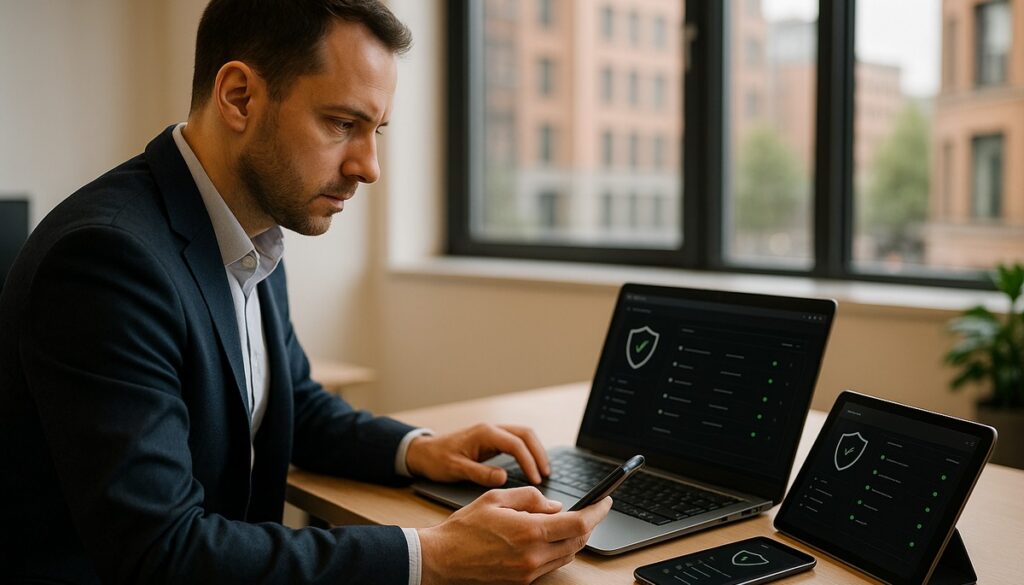
Every laptop, smartphone, tablet, and server connected to your business network is a potential entry point for cybercriminals. Endpoint security has become one of the most critical priorities for businesses across Manchester and Sale, particularly as hybrid working has scattered devices far beyond the traditional office perimeter. At PC Express IT, we help businesses build layered protection that covers every device, wherever it is used.
What Is Endpoint Security?
Endpoint security is the practice of protecting every device, or “endpoint,” that connects to your business network. This includes desktops, laptops, smartphones, tablets, printers, point-of-sale terminals, and increasingly smart building devices. Unlike traditional network security that concentrates on guarding the perimeter, endpoint security treats each device as an individual risk that must be monitored, managed, and protected in its own right.
The shift matters because modern attacks rarely come through the front door. Phishing emails land directly in an employee’s inbox. Malware hides inside a downloaded file. An unpatched phone connects to the company Wi-Fi and silently opens a backdoor. These threats bypass firewalls entirely, which is why endpoint security has moved from a nice-to-have into a business essential.
Why Every Device on Your Network Is a Risk
The average SME across Greater Manchester now runs between five and ten devices per employee. Add in shared equipment, guest Wi-Fi access, and the personal smartphones staff use to check company email, and the number of potential vulnerabilities multiplies quickly. Many businesses invest in strong server-level protection but leave individual devices largely unmanaged, creating exactly the gaps attackers look for.
Remote and hybrid working has made this worse. When a device leaves the office, it moves beyond the protection of your corporate network. It might connect through a home broadband router with no business-grade security, a coffee shop Wi-Fi, or a hotel network shared with hundreds of strangers. Without proper endpoint controls in place, each of those connections is a risk.
The Most Common Endpoint Threats Facing Manchester Businesses
Ransomware and Malware
Ransomware remains the dominant threat facing SMEs across the UK. Once it lands on a single unprotected device, it can spread laterally across the network within minutes, encrypting files and demanding payment before you can recover access. Modern ransomware variants specifically target businesses, often sitting dormant for weeks to map the network before activating. Traditional antivirus is not equipped to catch these threats, which is why businesses need endpoint detection and response (EDR) tools that monitor behaviour rather than just known signatures.
Phishing and Social Engineering
Phishing attacks arrive via email, SMS, and increasingly through collaboration tools like Microsoft Teams or WhatsApp. A convincing message prompts an employee to click a link, enter credentials, or download a file. Mobile devices are particularly vulnerable because the small screen makes it harder to spot suspicious URLs, and users are often in a rush. Endpoint security solutions that include email filtering, safe browsing controls, and device-level web protection are essential for closing this gap.
Unpatched Software and Operating Systems
Unpatched software is one of the most common root causes of successful cyberattacks. When a vulnerability is discovered in Windows, a browser, or a business application, attackers can exploit it within hours of the public disclosure. Businesses that do not apply patches promptly leave known open doors sitting unguarded. Proper endpoint management includes automated patch deployment so no device falls behind, regardless of whether it is in the office or working remotely.
Building a Robust Endpoint Security Strategy
Endpoint Detection and Response (EDR)
EDR platforms go significantly further than traditional antivirus. They monitor device behaviour continuously, looking for patterns that indicate an attack is underway, even if the specific malware has never been seen before. When suspicious activity is detected, EDR tools can automatically isolate the affected device from the network, contain the threat, and alert your IT team. For Manchester businesses without a full in-house security team, partnering with a managed IT provider that operates EDR on your behalf provides enterprise-grade protection at a fraction of the cost of building it yourself.
Mobile Device Management (MDM)
Mobile Device Management gives your IT team visibility and control over every smartphone and tablet connected to business resources. With MDM in place, you can enforce screen lock policies, require encryption, push security updates remotely, and wipe a device if it is lost or stolen. For businesses where staff access company email or documents on personal phones, MDM can be configured to manage only the work applications, keeping personal data separate and untouched. This is a critical layer of protection that many Sale and Altrincham businesses are still missing.
Privilege Management and Least-Access Principles
Not every employee needs administrator rights on their device. Privilege management ensures that staff accounts operate with the minimum access required to do their job, significantly limiting the damage a compromised account can cause. If an attacker gains access to a standard user account, they cannot install software, change system settings, or access restricted files. When combined with multi-factor authentication and zero trust principles, privilege management dramatically raises the bar for any attacker who makes it past the perimeter.
Remote Working and the Endpoint Security Challenge
Hybrid working is now the default for most Manchester businesses, and it has fundamentally changed the endpoint security challenge. When devices were office-bound, a strong perimeter firewall provided a reasonable baseline. Now, those same devices travel between homes, client sites, coffee shops, and co-working spaces, and each environment carries different risks.
A well-designed remote working security framework includes a business-grade VPN that encrypts all traffic from remote devices, endpoint security tools that operate independently of network location, and clear policies around which devices can access which resources. Our managed IT support packages include remote endpoint management as standard, ensuring that a device working from a kitchen table in Sale has the same level of protection as one sitting in your server room.
What Good Endpoint Security Looks Like in Practice
A robust endpoint security posture for a typical Manchester SME would typically include:
- EDR software deployed on every Windows, Mac, and Linux device with 24/7 monitoring
- Automated patch management for operating systems and third-party applications
- MDM covering all smartphones and tablets that access company data
- Enforced MFA on every business account, including Microsoft 365, email, and cloud applications
- Device encryption (BitLocker or FileVault) enabled by default on all endpoints
- Regular vulnerability scans to identify unpatched or misconfigured devices before attackers do
- User awareness training so staff can recognise and report threats before they escalate
None of these measures require a large IT department or a significant upfront investment. They do require consistent implementation and ongoing management, which is where many businesses without dedicated IT support fall short.
How PC Express IT Helps Manchester Businesses Stay Secure
We work with businesses across Sale, Altrincham, Trafford, and the wider Manchester area to implement and manage endpoint security that is proportionate to the size and risk profile of each organisation. That means no over-engineered enterprise solutions that swallow budgets, and no cut-corners approaches that leave gaps an attacker could walk through.
Our managed IT support includes continuous endpoint monitoring, patch management, MDM configuration, and incident response. If something happens on one of your devices at 2am on a Sunday, we know about it and can act before your team arrives at the office on Monday morning. We also handle the admin: device enrolment, policy deployment, compliance reporting, and the ongoing tuning that keeps protection effective as threats evolve.
Cyber Essentials certification, which requires demonsturable endpoint controls, is increasingly required by clients, insurers, and public sector contract frameworks. We help businesses achieve and maintain the certification as part of a broader security programme rather than as a one-off tick-box exercise.
The Bottom Line
Endpoint security is not optional for any business that operates in 2026. Every device on your network represents both a productivity tool and a potential liability, and managing that balance requires the right technology, the right policies, and the right support. The good news is that a well-implemented endpoint security strategy does not have to be expensive or complicated, it just has to be done properly.
If you are unsure how well-protected your business devices are right now, that uncertainty is itself worth addressing. Get in touch with PC Express IT for a free security assessment and find out exactly where your endpoints stand.