
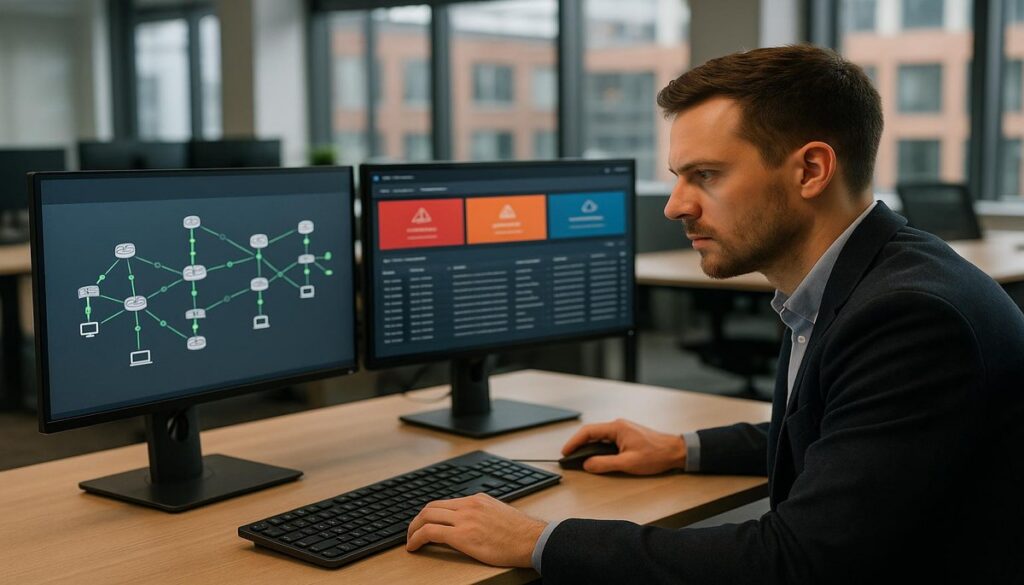
The Cybersecurity Visibility Problem
Manchester businesses face a relentless stream of cyber threats — from opportunistic ransomware to targeted credential theft. But defending your network starts with one thing: knowing what is actually happening on it.
Two technologies appear repeatedly in conversations about network visibility: network monitoring and SIEM. They are often conflated, sometimes sold as the same thing, and regularly misunderstood. This guide cuts through the noise and helps Sale and Manchester businesses decide which belongs in their IT stack — or whether they need both.
What Is Network Monitoring?
Network monitoring is the continuous observation of your IT infrastructure — devices, servers, switches, routers, firewalls, and internet connections — to detect performance problems, outages, and unusual traffic patterns.
What Network Monitoring Covers
A network monitoring system (NMS) typically tracks:
- Bandwidth usage and saturation points across your network
- Device availability (up/down status for all monitored assets)
- Interface errors and packet loss
- CPU and memory utilisation on network devices
- Latency between network segments and remote sites
- Traffic anomalies and unexpected consumption spikes
Common tools include PRTG, SolarWinds, and cloud-managed options such as Auvik. Many managed IT providers in Manchester include network monitoring as part of a fixed-fee service package.
What Network Monitoring Does Well
Network monitoring excels at operational visibility. You will know when your internet connection drops, when a switch port is failing, or when one department is consuming every byte of available bandwidth before your users raise a helpdesk ticket. For most Sale and Manchester SMEs, this is the most immediately actionable layer of IT visibility available.
What Is a SIEM?
SIEM stands for Security Information and Event Management. It is a platform that aggregates log data from across your entire IT environment — endpoints, servers, firewalls, cloud services, applications — correlates events, and generates security alerts when patterns suggest an attack or policy violation.
What a SIEM Covers
A SIEM pulls data from multiple sources simultaneously:
- Windows Event Logs (logon attempts, privilege changes, policy violations)
- Firewall and proxy logs
- Endpoint detection and response (EDR) agents across all managed devices
- Cloud service logs from Microsoft 365, Azure, and AWS
- Email security platform alerts
- VPN access records and identity provider sign-in logs
The platform then applies correlation rules and machine learning to detect patterns that suggest a genuine security incident.
What a SIEM Does Well
SIEMs are designed for security detection and compliance. Where network monitoring tells you your internet link is saturated, a SIEM tells you that 47 failed login attempts hit an account from an IP address in Romania at 3am — and succeeded on attempt 48. That kind of credential-based lateral movement is entirely invisible to a standard network monitor.
For regulated businesses across Manchester — legal firms, financial services, healthcare practices, and accountancy firms — SIEM data is often required for compliance with FCA, ICO, or Cyber Essentials Plus frameworks.
Network Monitoring vs SIEM: Key Differences
Purpose and Focus
Network monitoring is primarily an operational tool. It keeps your IT team informed about infrastructure health and supports fast incident diagnosis when something goes wrong. SIEM is primarily a security tool. It gives your security function the visibility to detect attacks, investigate incidents, and produce the evidence trail compliance frameworks require.
Data Sources
Network monitoring focuses on network device telemetry: interface statistics, flow data, and SNMP traps. A SIEM ingests logs from virtually every layer of your environment — operating systems, applications, cloud platforms, and identity providers. The scope difference is significant.
Complexity and Operational Overhead
Network monitoring is relatively straightforward to deploy. A well-configured NMS with sensible alert thresholds can be operational within hours and managed by a non-specialist IT administrator with modest training.
SIEMs are significantly more complex. Raw SIEM deployments generate enormous alert volumes, with many false positives. Without careful tuning, a SIEM rapidly becomes noise. Effective SIEM operation requires analysts who can write correlation rules, suppress benign patterns, and investigate genuine incidents systematically.
Cost
Network monitoring tools range from free (open-source solutions such as Zabbix or Grafana with Prometheus) to several hundred pounds per month for a managed subscription. Managed cloud-based SIEMs for SMEs typically start at £500—£1,000 per month, scaling with data ingestion volume and retention requirements.
This cost difference is one reason most Sale and Manchester SMEs begin with network monitoring and add SIEM capability as their security posture matures and their risk profile demands it.
Which Does Your Manchester Business Need?
You Almost Certainly Need Network Monitoring If…
- You have more than five networked devices in your office
- You have experienced unexplained downtime or persistent slow performance
- Your staff reports IT problems before your IT team is aware of them
- You are paying for managed IT support and want accountability and SLA data
- You want to reduce mean time to diagnosis when systems fail
Network monitoring is the baseline. Any Manchester business with a functioning IT environment should have some form of it in place. It reduces downtime, identifies problems early, and provides the data needed for capacity planning and IT investment decisions.
You Likely Need a SIEM If…
- You operate in a regulated sector (financial services, legal, healthcare, accountancy)
- You hold sensitive client or patient data at scale under UK GDPR
- Your cyber insurer requires log aggregation and monitoring as a condition of cover
- You have already achieved Cyber Essentials and are working towards Cyber Essentials Plus
- You have experienced a security incident and need ongoing threat detection capability
- You supply goods or services to public sector clients with security requirements
What About Managed Detection and Response?
Many smaller Manchester businesses that need SIEM-level security without the internal resource to run one turn to Managed Detection and Response (MDR) providers. An MDR service combines SIEM technology with a dedicated team of security analysts who handle alert triage, investigation, and incident response on your behalf — delivering enterprise-grade protection without requiring an in-house security operations centre.
This is an increasingly popular path for Greater Manchester businesses that face genuine cyber risk but cannot justify the overhead of full internal SIEM operations. MDR services typically sit between standalone SIEM and a fully staffed SOC in both cost and capability.
Do You Need Both?
In most mature IT environments, both network monitoring and SIEM are present, serving distinct purposes.
Network monitoring feeds your operational support function. Your helpdesk uses it to diagnose issues faster, spot degradation before users are affected, and report on infrastructure health trends over time.
A SIEM feeds your security function. It detects attacks, supports incident investigation, and produces the evidence trail compliance frameworks require at audit time.
The two are also complementary: unusual traffic patterns flagged by your network monitor can correlate with suspicious authentication events surfaced in your SIEM. Together, they build a far fuller picture of what is actually happening across your environment — operational and security — than either tool delivers alone.
Getting Started in Sale and Manchester
If your Manchester business currently has neither, network monitoring is the right first step. It delivers immediate, measurable value, is straightforward to implement, and creates the foundational visibility your IT team needs to operate effectively day to day.
If you already have network monitoring in place but face regulatory pressure, tightening cyber insurance requirements, or have recently experienced a security incident, it is worth having an honest conversation about whether a managed SIEM or MDR service is appropriate for your risk profile.
PC Express IT works with businesses across Sale, Altrincham, Trafford, Salford, and Greater Manchester to design monitoring and security architectures that match real business risk — not a vendor sales catalogue. Our IT support team can walk you through an initial assessment at no obligation. Get in touch to arrange a conversation.
Frequently Asked Questions
What is the difference between network monitoring and SIEM?
Network monitoring tracks the performance and availability of your IT infrastructure — routers, switches, servers, and connections. A SIEM aggregates security event logs from across your environment and applies correlation rules to detect cyber threats. Network monitoring is an operational tool; SIEM is a security tool. Both are useful, but they solve different problems.
Does a small Manchester business need a SIEM?
Not necessarily straight away. Most small Manchester businesses benefit most from implementing network monitoring first. SIEM becomes relevant once you are handling sensitive data at scale, operating in a regulated sector, or face specific compliance requirements from a cyber insurer, supply chain partner, or industry body.
How much does a SIEM cost for an SME?
Managed cloud SIEM services for SMEs typically start at around £500—£1,000 per month, scaling with data ingestion volume and retention period. Self-hosted open-source options such as Wazuh or OpenSearch SIEM can reduce licensing costs significantly but require internal expertise to deploy and maintain effectively.
Can network monitoring replace a SIEM?
No. Network monitoring can detect performance anomalies and some traffic-based attacks, but it cannot correlate security events across your entire environment or surface credential-based attacks, insider threats, or application-layer breaches. SIEM — or a managed equivalent such as MDR — is required for that level of security visibility.
What is MDR and how does it relate to SIEM?
Managed Detection and Response (MDR) is a service that combines SIEM technology with a team of security analysts who monitor, triage, and respond to threats on your behalf. It is a practical option for Greater Manchester SMEs that need SIEM-level security without the resources to run a full security operations centre in-house.
How do I know if my business is ready for a SIEM?
Key indicators include: operating in a regulated sector, facing cyber insurance log-retention requirements, holding sensitive client data, having experienced a security incident, working towards Cyber Essentials Plus, or supplying public sector clients with security obligations. PC Express IT can carry out an IT security assessment for your Manchester business to help clarify your position.
Can PC Express IT help with network monitoring and SIEM for my Manchester business?
Yes. PC Express IT provides managed IT support and security services across Sale, Manchester, Altrincham, and the wider Trafford area. We can design, implement, and manage network monitoring solutions and advise on SIEM or MDR services appropriate for your business size and risk profile. Contact us to discuss your requirements.